
Introduction
What if accessibility was simply part of everyday life in Jamaica? By making our schools, workplaces and public services more inclusive, we can help create a Jamaica where everyone has a fair chance to participate.
Imagine a Jamaica where accessibility is not something people have to ask for. A Jamaica where a Deaf person can enter a public office and communicate more easily. Where important information is available in accessible formats. Where schools, workplaces, businesses, and public services consider different communication needs from the beginning. That is the kind of Jamaica we should be working towards.
A Growing Conversation About Accessibility
In July, Jamaica’s Ministry of Labour and Social Security announced plans to strengthen disability inclusion by improving connections across its agencies, programmes, and services. One important message stood out: accessibility needs to become part of Jamaica’s culture. That is a powerful idea. Because true inclusion is not simply about creating one accessible programme or making an accommodation when someone asks.
It is about building accessibility into the way we do things every day.
Communication Is Part of Accessibility
For members of Jamaica’s Deaf and Hard-of-Hearing communities, one important part of accessibility is communication. Earlier this year, we saw encouraging examples of this receiving greater attention. Public library staff across Jamaica began receiving Jamaican Sign Language training to help better serve Deaf and Hard-of-Hearing visitors. More recently, members of the Jamaica Constabulary Force completed training in Jamaican Sign Language and Deaf Culture, helping officers develop skills that can support better communication with members of the Deaf community.
These are meaningful steps. But they also remind us that accessibility should not exist in only a few places. A Deaf Jamaican may interact with a bank, hospital, school, supermarket, government office, police station, workplace, or business on any given day. Communication matters in all of these spaces.
Inclusion Can Start With Learning
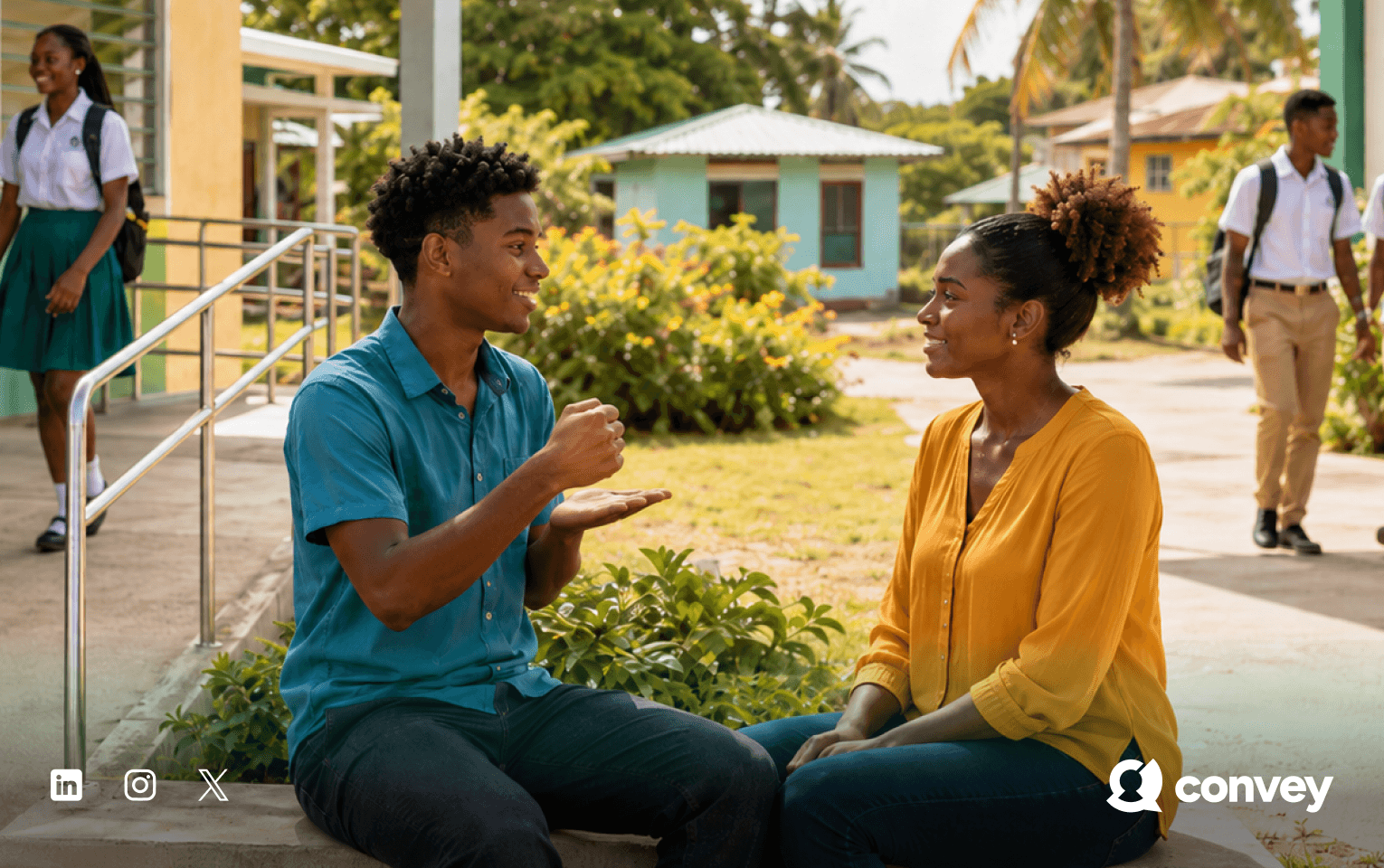
Not everyone needs to become fluent in Jamaican Sign Language overnight. But more Jamaicans can take the first step towards understanding it. You might start by learning the JSL alphabet. You might learn how to fingerspell your name. A teacher might become curious about communicating more inclusively with a Deaf student. A hearing parent of a Deaf child might begin learning alongside their family. A business might encourage employees to learn basic communication skills or work with members of the Deaf community to improve accessibility. Small steps can help create greater awareness. And greater awareness can help change culture.
Where Convey Fits In
At Convey, we believe learning should be accessible, engaging, and easy to begin.
That is why we have created self-paced resources that introduce people to Jamaican Sign Language through digital and physical learning experiences. Our website allows anyone to begin exploring the JSL alphabet, numbers, and fingerspelling online. Our JSL Fingerspelling Workbook provides another way for learners to practise through simple activities at their own pace. These resources are designed as a starting point.
They do not replace the Deaf community, Deaf educators, interpreters, or formal Jamaican Sign Language instruction. Learning JSL should always be approached with respect for the language, culture, experiences, and expertise of Jamaica’s Deaf community. Our hope is simply to make that important first step easier for more people to take. Because if accessibility is going to become part of Jamaica’s culture, all of us have a role to play. And sometimes, change can begin with something as simple as learning your first sign.
Start Your JSL Journey
Take your first step today. Visit conveytoolkit.com to practise the Jamaican Sign Language alphabet, learn numbers, and explore fingerspelling online. You can also order the JSL Fingerspelling Workbook and continue practising through fun, self-paced activities.
Learn a sign. Start a conversation. Help make inclusion part of everyday Jamaica.